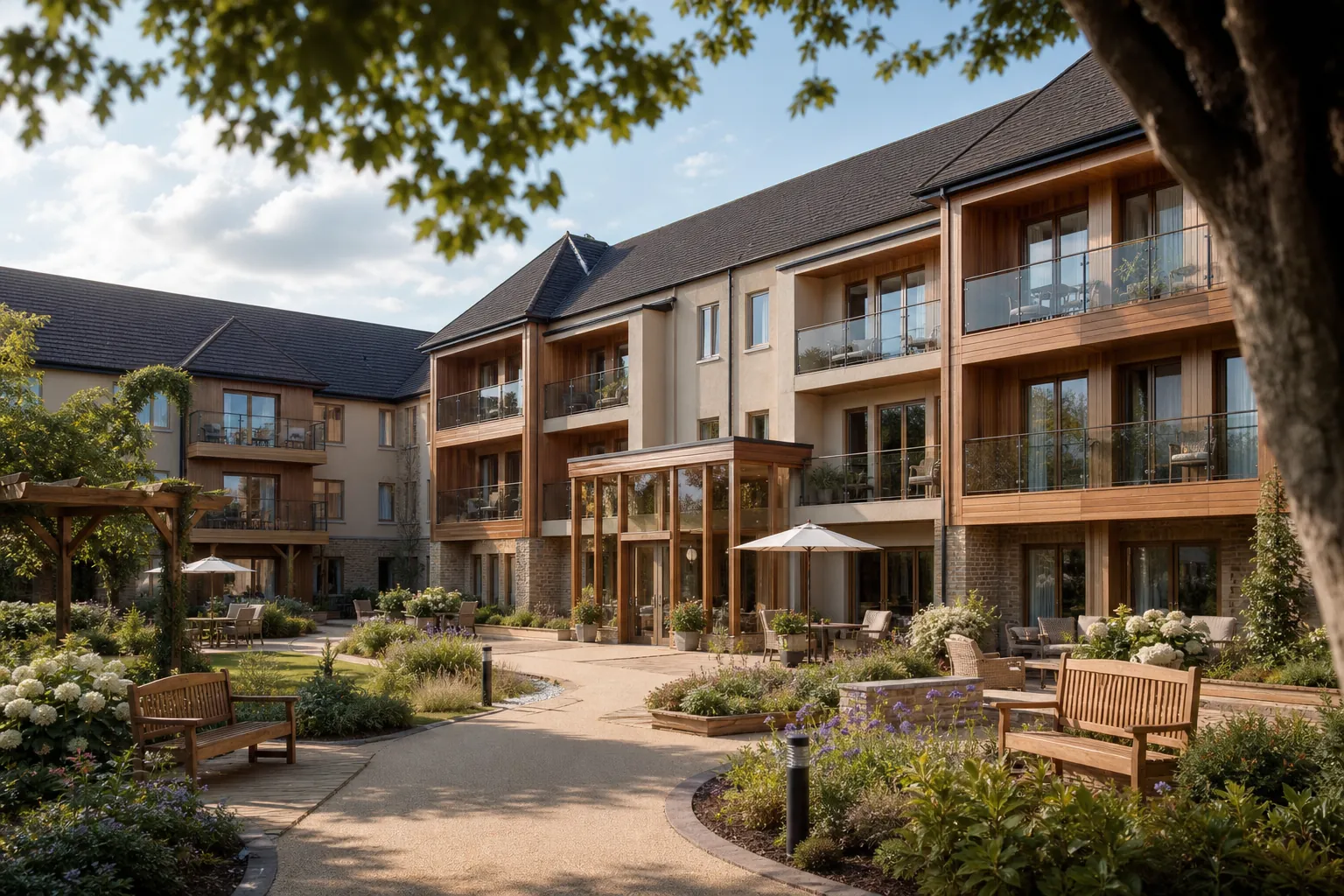
Assisted living property investment finance
Funding for assisted living and extra care schemes, age-restricted housing with care on hand, underpinned by an ageing population and a long demand runway.

Funding assisted living
Assisted living is age-restricted housing where residents live independently in their own apartment but with care, support and communal facilities available on site. It sits between mainstream retirement housing and a care home: residents keep their own front door, while staff, communal space and a service charge provide the support that makes staying put possible as needs grow. Extra care schemes are the larger, more care-rich end of the same model.
The investment case rests on demographics and the service-charge model, and the finance has to read both. Income can come from outright or shared-ownership sales, from rent, or from a long lease to an operator, and each routes the deal to different lenders. We arrange acquisition, development and term debt for assisted living and extra care, presenting the age-related demand, the scheme model and the exit the way credit teams assess them.
What we fund
- Assisted living apartment schemes with communal facilities and on-site care
- Extra care schemes with higher care provision and registered services
- Age-restricted housing let, sold outright or sold on shared ownership
- Schemes operated on a lease to a care or housing operator
- Conversions of redundant buildings to assisted living standard
- Mixed-tenure later-living developments combining sale and rented homes
Indicative terms
- Typical lot size (indicative)£1m to £25m and above
- Development funding (indicative)Up to ~60 to 70% of cost
- Term LTV (indicative)Up to ~60 to 70% of value
- Market contextUK assisted living market £11.5bn (IBISWorld)
Indicative only. Terms vary by lender, asset and borrower and are not an offer of finance.
Funding assisted living and extra care schemes
We arrange finance across the life of an assisted living scheme. For a ground-up or conversion development we source development finance against cost, indicatively up to 60 to 70 percent, with the exit a sale of the homes or a refinance onto term debt. For a trading or let scheme we arrange a commercial mortgage or term loan sized on the income, whether that is rent, service-charge income or a lease to an operator. Where the scheme sells units, we structure the debt around the sales programme. Where equity is short, we introduce mezzanine finance or equity and joint venture capital. We act as arranger and introducer, not as a lender.
Which lenders fund assisted living, and what they assess
Assisted living draws development lenders, challenger banks, specialist healthcare and living-sector lenders and, on stabilised schemes, mainstream banks. What they underwrite depends on the model. On a development, lenders test build cost, the planning position, the demand for age-restricted homes in the catchment and the sales or letting assumptions. On a trading or let scheme, they look at the income source: a lease to an operator brings the operator's covenant into play, a rented scheme brings occupancy and the service-charge model, and a sales scheme brings absorption rates. Across all of them, the age-related demand thesis is the backdrop, with the over-85 population projected to reach around 3.0 million by 2043 on ONS figures. We match the model to the lenders active in that exact part of the later-living market.
The market for assisted living and extra care
Assisted living investment is underpinned by one of the clearest demand stories in UK property. The IBISWorld assisted living market is estimated at £11.5bn and has grown around 9 percent a year over the past five years, while the over-85 population, the core market, is projected to nearly double to around 3.0 million by 2043 on ONS figures. That demographic runway is why institutional capital has moved into later living, with CBRE recording £3.2bn into the wider UK Living sector in Q3 2025. Exit routes follow the model: development schemes exit through unit sales or a refinance onto investment debt, let schemes through a sale to a later-living investor or operator, and the strongest stabilised assets attract institutional buyers. We frame each scheme around the exit a lender will want to see before it commits.
Finance that suits this asset class
- Development financeFunding ground-up and conversion schemes against project cost.
- Commercial mortgagesTerm debt on a let or trading assisted living scheme.
- Equity and JVCompleting the capital stack where developer equity is the constraint.
Useful calculators
Related guides
Fund a assisted living deal
A view on fundability within one working day.
Are assisted living properties a good investment?
On the demand side the case is strong and well evidenced. The UK over-85 population is projected to reach around 3.0 million by 2043 on ONS figures, the assisted living market is estimated at £11.5bn growing around 9 percent a year on IBISWorld data, and bed and unit supply is not keeping pace. That structural imbalance between an ageing population and constrained supply is the foundation of the investment thesis, and it is real rather than promotional.
Whether a specific scheme is a good investment, though, turns on the fundamentals lenders test: the catchment's wealth and age profile, the service-charge model, the operator or care arrangement, and the exit. We do not give investment advice and we do not sell investment property; our role is to arrange the finance, and we present the demand evidence and the scheme economics in the form a lender underwrites.
What is one of the biggest drawbacks of assisted living as an investment?
The most common pitfall is the service-charge and operational model rather than the bricks. Assisted living depends on communal facilities, staff and services funded through a service charge, and a scheme that is poorly designed, under-occupied or saddled with an uncompetitive service charge can struggle even where the demand is real. Where income depends on a single operator, the operator's covenant becomes a concentration risk a lender will probe.
There can also be liquidity and resale considerations on age-restricted stock, and on some operator-led or fractional models the exit is narrower than mainstream residential. We flag these honestly because lenders flag them too: the strength of the operator, the realism of the service charge, and the clarity of the exit are exactly what determine whether a scheme funds well or not.
How does the income model shape the finance?
Assisted living income arrives in different shapes, and each routes the deal differently. A scheme that sells apartments outright or on shared ownership is financed like a residential development, with the loan repaid from sales. A rented scheme is financed on its rental and service-charge income, with occupancy the key variable. A scheme let on a lease to an operator is financed on that lease and the operator's covenant, closer to the supported living model.
Getting the model right at the outset matters because it decides the lender, the leverage and the exit. We establish early whether a scheme is a sales play, an income play or a lease-backed play, then take it to the lenders that fund that model, rather than forcing one structure onto every scheme.
Is a realistic return achievable, and how do lenders view yield claims?
Returns in assisted living vary widely with the model and the catchment, and headline yield figures quoted by sellers should be treated with care. Lenders do not lend against a promoted yield; they lend against evidenced income and a defensible value. For comparison, Knight Frank puts prime care home yields at around 4.5 percent and long-lease supported housing nearer 5 to 6 percent, which frames the range the wider sector trades in.
What a lender wants is income it can verify and an exit it can see, not a target return. We present the actual or projected income, the operator or sales evidence, and the valuation basis, and we let the lender size the debt against that. A scheme stress-tested on conservative occupancy and a realistic service charge funds far more reliably than one sold on an optimistic gross yield.
How is assisted living different from a care home or supported living?
Assisted living sits between the two. Unlike a care home, residents live independently in their own homes rather than as residents of a registered care business, so the asset is usually housing with services rather than an operating going concern. Unlike specialist supported housing, the residents are typically older people funding their own homes or rent rather than working-age adults on a registered-provider lease backed by housing benefit.
That middle position means the finance can look like a residential development, an income investment or a lease-backed deal depending on how the scheme is set up. We identify which it is and underwrite it as that, while keeping the lender's eye on the demographic demand that supports the whole later-living sector. Where a scheme tips into registered care, it moves onto the care home model and its operator and CQC tests.
Worked example: developing an assisted living scheme
Take an illustrative development: an operator builds a 40-apartment assisted living scheme with communal facilities on a site bought for £2m, at a build and fit-out cost of £8m, so £10m all-in. These figures are illustrative only and not an offer of finance; any real facility would be sized on the actual site, costs, planning and exit.
Development finance at 65 percent of cost would advance around £6.5m, with the developer funding roughly £3.5m through equity and the land value. Where the equity requirement is tight, a mezzanine facility behind the senior loan, or an equity and joint venture partner, can complete the stack at a cost below giving away the whole project.
The exit depends on the model. If the apartments are sold, the development loan is repaid from the sales programme as homes complete and sell. If the scheme is held and let, it refinances at stabilisation onto a term loan sized on the rental and service-charge income, indicatively up to 60 to 70 percent of the stabilised value, repaying the development debt and releasing equity.
Across either route, the lender keeps one eye on the demographic backdrop, an over-85 population projected to reach around 3.0 million by 2043 on ONS figures, and one on the scheme's own numbers. We size the debt against the evidenced exit, not the demand story alone.
Illustrative worked example only. Figures vary by lender, asset and borrower and are not an offer of finance.
Frequently asked questions
Are assisted living properties a good investment?
The demand case is strong: the UK over-85 population is projected to reach around 3.0 million by 2043 on ONS figures, and the assisted living market is estimated at £11.5bn growing around 9 percent a year on IBISWorld data. Whether a specific scheme works turns on the catchment, the service-charge model, the operator and the exit. We arrange the finance and do not give investment advice.
What is one of the biggest drawbacks of assisted living?
The main risks sit in the operational model rather than the building: an uncompetitive service charge, under-occupancy, dependence on a single operator's covenant, and sometimes a narrower resale market on age-restricted stock. Lenders probe exactly these points, which is why the operator, the service charge and the exit drive how well a scheme funds.
How does assisted living differ from a care home?
In assisted living residents live independently in their own homes with care available, so the asset is usually housing with services. A care home is a registered operating business where residents are cared for, underwritten on operator trading, occupancy and CQC rating. The finance models differ accordingly.
Is this lending regulated?
Most assisted living and later-living finance arranged for corporate and experienced-investor borrowers is unregulated business lending. Some lending to individuals can be a regulated mortgage contract; where it is, we refer it to an appropriately authorised firm. Indicative terms are illustrative and not an offer of finance.
Funding a assisted living asset?
Tell us about the deal and we will come back with a view on fundability and likely terms.