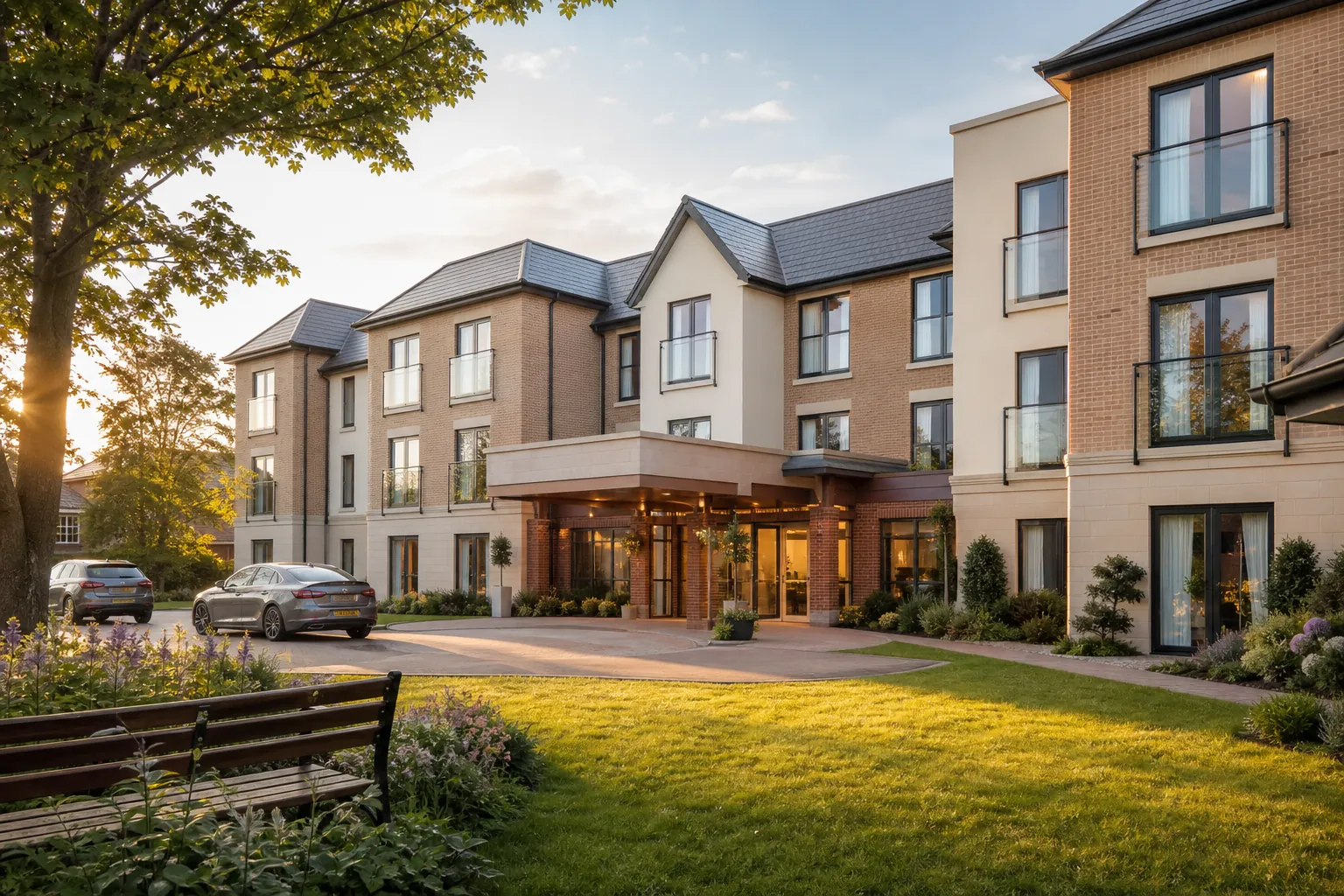
Care home development finance
Care home development finance funds the building of a new care home, extra care scheme or supported living development, or a major conversion, from land purchas

Care home development finance funds the building of a new care home, extra care scheme or supported living development, or a major conversion, from land purchase through to a trading or let asset. Unlike a standard residential development loan, it is underwritten against a building that will become an operating care business or a leased supported housing scheme, so the lender looks beyond the build to the income and the exit at the far end.
This guide explains how care and supported living development finance works: how loans are sized on cost and value, the role of a pre-let or forward funding, what build cost and planning involve, and how the development exits onto investment debt or a sale. We arrange this finance as a broker and introducer. We are not a lender, and nothing here is investment, tax or legal advice; worked figures are illustrative only.
What is care home development finance?
Care home development finance is short-to-medium-term funding that pays for the construction or conversion of a care or supported living asset, drawn down in stages as the build progresses and repaid when the scheme is complete and either trading, let or sold. It covers the spectrum from a ground-up new build on a bare site to the conversion of an existing building into a care home, extra care scheme or specialist supported housing.
It is distinct from the term loan that follows it. Development finance carries the construction risk and is priced for it, then is replaced at completion by cheaper long-term debt or repaid from a sale. The discipline of the sector is that the development loan and its exit are planned together from the start: a lender funding the build wants to see a credible, evidenced route to repayment, whether that is a refinance onto an investment loan once the asset is trading or let, or a forward sale to an institution.
How is a development loan sized?
Development finance is measured against two figures: loan to cost and loan to gross development value. Loan to cost is the loan as a percentage of the total project cost, including land, build, professional fees and finance costs. Loan to gross development value, or loan to GDV, is the loan as a percentage of the finished scheme's value once complete. Lenders set a ceiling on both, and the lower of the two limits caps the loan.
The developer funds the gap between the loan and the total cost with equity, and sometimes with a layer of mezzanine finance sitting behind the senior development loan to reduce the equity needed. The amount of equity required depends on how the project appraises: a scheme with a strong end value relative to its cost, a pre-let or a forward sale in place, supports a higher loan and a lower equity requirement than a speculative build. We model the senior, mezzanine and equity layers together so a developer can see the whole capital stack before committing to the site.
Why do pre-let and forward funding matter?
A pre-let or forward-funding agreement transforms a development from a speculative build into a far safer, more financeable proposition. For supported living, a pre-let means a registered provider has agreed to take a lease of the completed scheme, so the income and the exit are largely fixed before a brick is laid. For a care home, a forward agreement might involve an operator committed to lease or run the home, or an institution committed to buy the finished asset.
Lenders price and gear development finance very differently with a pre-let or forward sale in place, because the biggest risk in any development, whether the finished building can be let or sold at the assumed value, is substantially removed. Forward funding, where an institutional investor funds the build in exchange for owning the completed asset, can de-risk delivery further and reduce the developer's own equity. Securing a credible provider or institutional commitment early is often the single most valuable thing a developer can do for the financeability of a care scheme.
What do build cost and the appraisal involve?
The development appraisal is the spine of any care scheme finance. It sets out the land cost, the build cost, professional and statutory fees, finance costs, a contingency and the gross development value, then derives the profit and the equity required. Lenders scrutinise every line, and they expect the build cost to be supported by a credible contractor or quantity surveyor rather than an optimistic estimate.
Care and supported living buildings carry costs beyond a standard residential scheme: adaptations, assistive technology, communal and care space, sprinklers and fire safety, and the fit-out a Care Quality Commission registered operation or a supported living provider requires. The end value, in turn, reflects what the completed asset is worth, whether as a trading care home valued near the £100,000 to £150,000 per bed indicative range on Knight Frank and care market commentary, or as a leased supported housing scheme valued on its registered-provider lease at indicative net yields of around 5 to 6 percent on the Knight Frank UK Living Sectors Yield Guide and market commentary. A realistic appraisal that lenders can trust is what gets a scheme funded.
How does planning affect care development finance?
Planning is a precondition of development finance, because no lender funds a build it is not confident can legally be delivered. The planning use class matters: a care home generally falls within use class C2, residential institutions, while supported living and extra care can sit in C2, C3 dwellinghouses, or be treated as sui generis depending on the design and the care offer, and a supported housing HMO may need its own consent. Getting the use class and any change of use right is fundamental, and we cover it in our dedicated guide.
Lenders treat planning status as a risk gauge. A scheme with full detailed planning consent in place is far more financeable than one reliant on a consent still to be won, and some lenders will only fund once planning is secured. Where a developer wants to buy a site before planning is settled, a bridge can fund the land purchase, with the development loan following once consent is granted. The cleaner the planning position, the keener the development finance terms.
How does a development exit onto long-term finance?
Every development loan needs an exit, and there are two main routes. The first is a refinance: once the scheme is built and either trading as a care home with maturing occupancy or let to a registered provider on a lease, the developer refinances the development loan onto a long-term investment loan or commercial mortgage at a keener rate. The second is a sale: the completed asset is sold to an operator, an investor or an institution, repaying the development loan from the proceeds.
Planning the exit at the outset is what makes the whole project bankable. A development funded with no clear exit is the riskiest kind of borrowing, whereas one with a pre-let provider lease and a refinance lined up, or a forward sale agreed, is a controlled, financeable proposition. We arrange the development finance and the term debt or sale that exits it together, so the journey from land to stabilised asset is mapped and priced from the start. We act as a broker and introducer, not a lender.
Care home development finance: common questions
What is care home development finance?
It is short-to-medium-term funding for building or converting a care home, extra care scheme or supported living development, drawn in stages as the build progresses and repaid at completion from a refinance onto long-term debt or a sale. It is sized on loan to cost and loan to gross development value, and lenders look at the income and exit at the far end as well as the build itself. We arrange it as a broker and introducer.
How much of a care development will a lender fund?
Development finance is capped by the lower of loan to cost and loan to gross development value, with the developer funding the balance in equity, sometimes topped up with mezzanine finance. A scheme with a pre-let to a registered provider or a forward sale in place supports a higher loan and lower equity than a speculative build. The exact figures depend on the appraisal, the covenant and the planning position.
What is a pre-let in supported living development?
A pre-let is an agreement, made before the build, under which a registered provider commits to take a lease of the completed supported living scheme. It largely fixes the income and the exit in advance, which substantially de-risks the development and improves the finance terms. For care homes, an equivalent forward agreement might involve an operator committed to run the home or an institution committed to buy it.
How does a care development exit its finance?
Either by refinance or by sale. Once built and trading or let, the scheme is refinanced from the development loan onto a long-term investment loan or commercial mortgage, or the completed asset is sold to an operator, investor or institution, repaying the development loan from the proceeds. Planning the exit at the outset is what makes the project financeable. We arrange both the development finance and its exit.
Ready to talk about a real deal?
Send us the deal and we will come back with a view on fundability and likely terms within one working day.