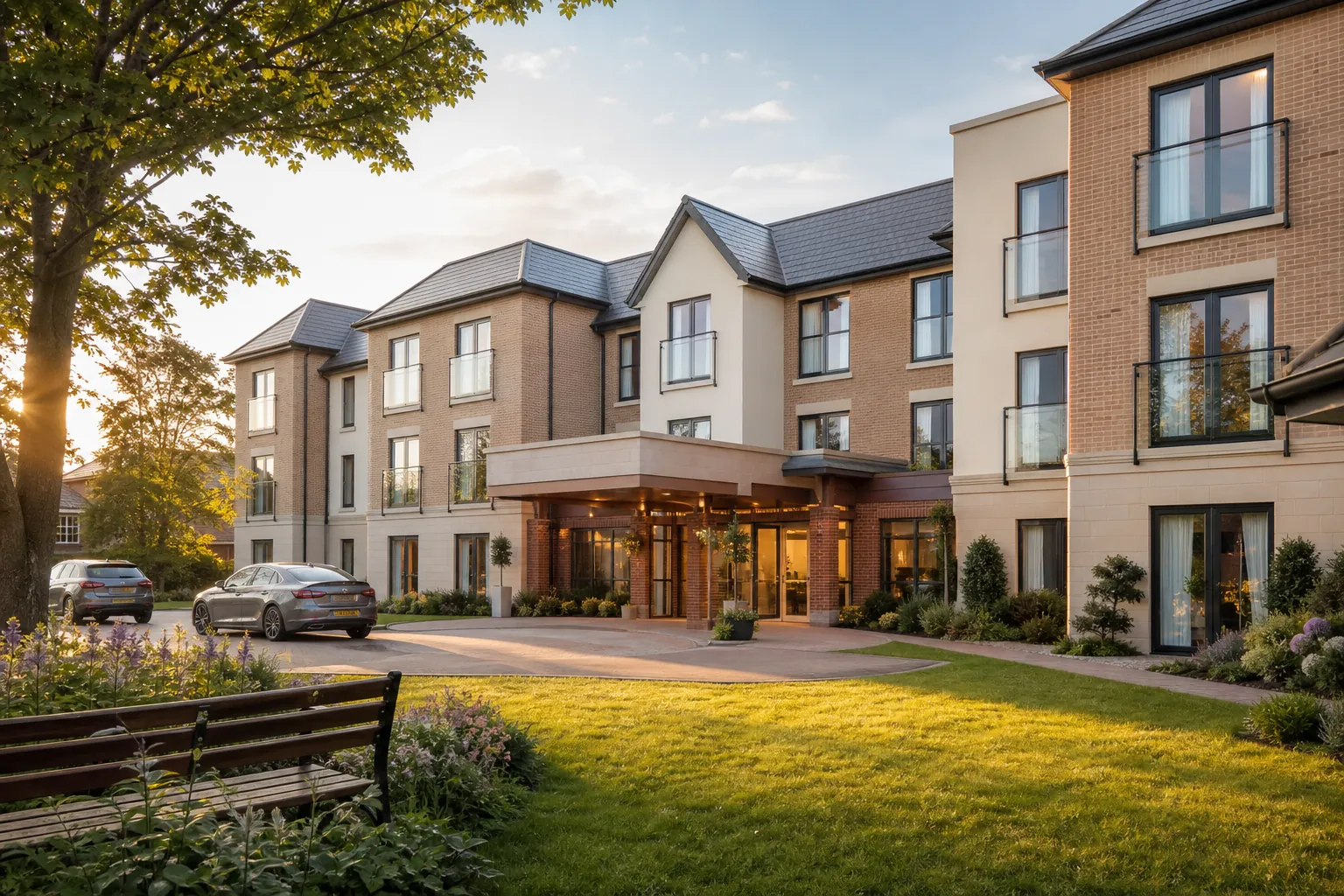
How to finance a care home
Financing a care home means borrowing against a trading business and the property that houses it in a single transaction. The income that repays the loan comes

Financing a care home means borrowing against a trading business and the property that houses it in a single transaction. The income that repays the loan comes from residents and the local authorities and health bodies that fund them, so a lender underwrites the operator's profitability and occupancy as much as the bricks. That makes care home finance a specialist discipline closer to business lending than to a standard buy-to-let mortgage.
This guide walks through how care home finance actually works: the products available, how lenders read the numbers, how much deposit you need, and the route from offer to drawdown. We arrange this finance as a broker and introducer. We are not a lender, and nothing here is investment, tax or legal advice; worked figures are illustrative only.
What finance products are available for a care home?
The core product is a commercial mortgage, also called a term loan, secured on the going-concern value of the home and serviced from its trading profit. This is what funds the purchase of an established, trading care home, typically over a term of up to 20 to 25 years. For homes that are still stabilising, or where the buyer is improving a turnaround situation, lenders may structure the debt with an interest-only period or covenants that flex as the home matures.
Around the term loan sit other products for specific situations. Bridging finance funds a fast purchase, an auction lot or a home that needs work before a term lender will take it. Development finance funds a ground-up build or a major conversion. Mezzanine finance and equity or joint-venture capital can sit behind the senior loan to reduce the cash deposit. Refinance releases capital from a home you already own or moves it onto better terms once trading has improved. We arrange all of these and match the product to the situation rather than the other way round.
How do lenders assess a care home?
Lenders underwrite the operator and the trading income first. The central measure is EBITDARM, the earnings before interest, tax, depreciation, amortisation, rent and management, which captures the home's underlying operating profitability. The average operator EBITDARM margin reached 30.1 percent in 2025, up around four points year on year, on the Knight Frank UK Care Homes Trading Performance Review 2025, and a home running at or above that level on durable income is a stronger credit than one below it.
Occupancy and fee mix come next. Average care home occupancy ran at 88.7 percent in 2025 and the average weekly fee reached £1,298, up 9.8 percent year on year, both on the Knight Frank review. A lender wants mature occupancy near or above that average, a healthy share of higher-paying private residents alongside local-authority income, a stable or improving Care Quality Commission rating and a capable registered manager. They size the loan so the home can still service its debt if occupancy slips several points, and they check the bricks-and-mortar value of the building as their downside security.
How much deposit and what loan to value?
Care home lending is sized against the going-concern valuation, and in our experience the loan to value for an established, well-occupied home typically lands somewhere in the region of 60 to 70 percent, which means a buyer should plan for a deposit of roughly 30 to 40 percent of the price plus stamp duty, professional fees and a working capital buffer. The exact figure depends on the trading record, the operator's experience and the quality of the building.
Experience moves the numbers materially. A first-time operator buying a home will usually gear lower and price wider than an established care group with a track record, because the lender is underwriting the management as much as the asset. A turnaround home with thin or volatile trading records also gears lower, and sometimes suits a bridging loan first, with a refinance onto cheaper term debt once the improved numbers are proven. We cover deposits and loan to value in more depth in our dedicated guide.
What does a care home purchase cost beyond the price?
The headline price is only part of the cash requirement. Commercial stamp duty land tax applies to the property element of the purchase and is a significant cost on a multi-million-pound home. Professional fees include legal work on the purchase and the lease or title, the lender's valuation of the going concern, the buyer's own accountant and adviser costs, and arrangement and broker fees on the finance itself.
Beyond the transaction, a buyer needs working capital. A care home has a continuous payroll, food, utilities and regulatory costs to meet from day one, and a sensible buyer holds a buffer to cover the period while they settle into ownership and, if needed, improve occupancy. As a purely illustrative rule of thumb, the all-in cash requirement on a care home purchase is the deposit plus stamp duty and fees plus a working capital reserve, which can take the total well above the headline deposit figure. These are illustrations, not an offer of finance.
What about financing different care property types?
The credit test changes with the asset. A trading residential care home or nursing home is underwritten on operator EBITDARM, occupancy and fee mix, as above. A supported living or specialist supported housing asset let to a registered provider is underwritten instead on the lease and the provider covenant, because the income is a long index-linked rent rather than trading profit, and those assets have traded at indicative net yields of around 5 to 6 percent on the Knight Frank UK Living Sectors Yield Guide and market commentary.
Extra care and retirement living schemes sit between the two, funded on rental income and covenant where they are income-producing, and on development appraisal and sales values where they are for sale. The practical point is that there is no single care finance product: the right structure depends on whether you are buying trading income, a lease covenant or a development. We arrange across all of these and match the lender to the asset, because the lenders active in trading care homes are not always the same as those active in lease-based supported housing.
What does the route from offer to drawdown look like?
A care home purchase runs in stages. After an initial enquiry and confidentiality agreement, the seller or agent releases trading information. The buyer makes an indicative offer, usually subject to diligence and funding, and the parties sign heads of terms with a period of exclusivity. During exclusivity, three workstreams run in parallel: financial and legal due diligence, the lender's valuation and credit approval, and the drafting of the purchase agreement.
Having finance agreed in principle before offering makes a buyer more credible and shortens the path to completion, which is something we arrange up front. As an illustration rather than a rule, a clean single-home purchase often takes three to six months from offer to completion. The credit process itself runs from terms in principle, through valuation and full credit approval, to the legal work and drawdown of funds at completion. We manage the finance side throughout and keep it aligned with what the diligence uncovers. We act as a broker and introducer, not a lender.
How to finance a care home: common questions
Can you get a mortgage on a care home?
Yes, through a commercial mortgage, sometimes called a care home mortgage or term loan, secured on the going-concern value and serviced from trading profit. Lenders underwrite the operator's EBITDARM, occupancy, fee mix and Care Quality Commission rating, and size the loan with headroom. In our experience loan to value for an established home is typically around 60 to 70 percent. We arrange these as a broker and introducer, not a lender.
How much deposit do you need to buy a care home?
In our experience an established, well-occupied care home typically gears to around 60 to 70 percent loan to value, so a buyer should plan for a deposit of roughly 30 to 40 percent of the price, plus stamp duty, professional fees and working capital. First-time operators and turnaround homes usually gear lower. The exact figure depends on the trading record, the building and the buyer's experience.
How do lenders value a care home?
Lenders instruct a Red Book valuation of the going concern, capturing the property, the fit-out and the trading business together. They size the loan against that going-concern value and test debt service against sustainable EBITDARM with headroom, while also noting the bricks-and-mortar or vacant possession value as their downside security. The average operator EBITDARM margin was 30.1 percent in 2025 on the Knight Frank review.
Is care home finance regulated?
Most care home finance arranged for corporate and experienced-investor borrowers is unregulated business lending outside the Financial Conduct Authority's regulated-mortgage perimeter. Some lending to individuals can be a regulated mortgage contract, which we refer to an appropriately authorised firm. We do not provide financial, legal or tax advice; indicative terms vary by lender, asset and borrower and are not an offer of finance.
Ready to talk about a real deal?
Send us the deal and we will come back with a view on fundability and likely terms within one working day.