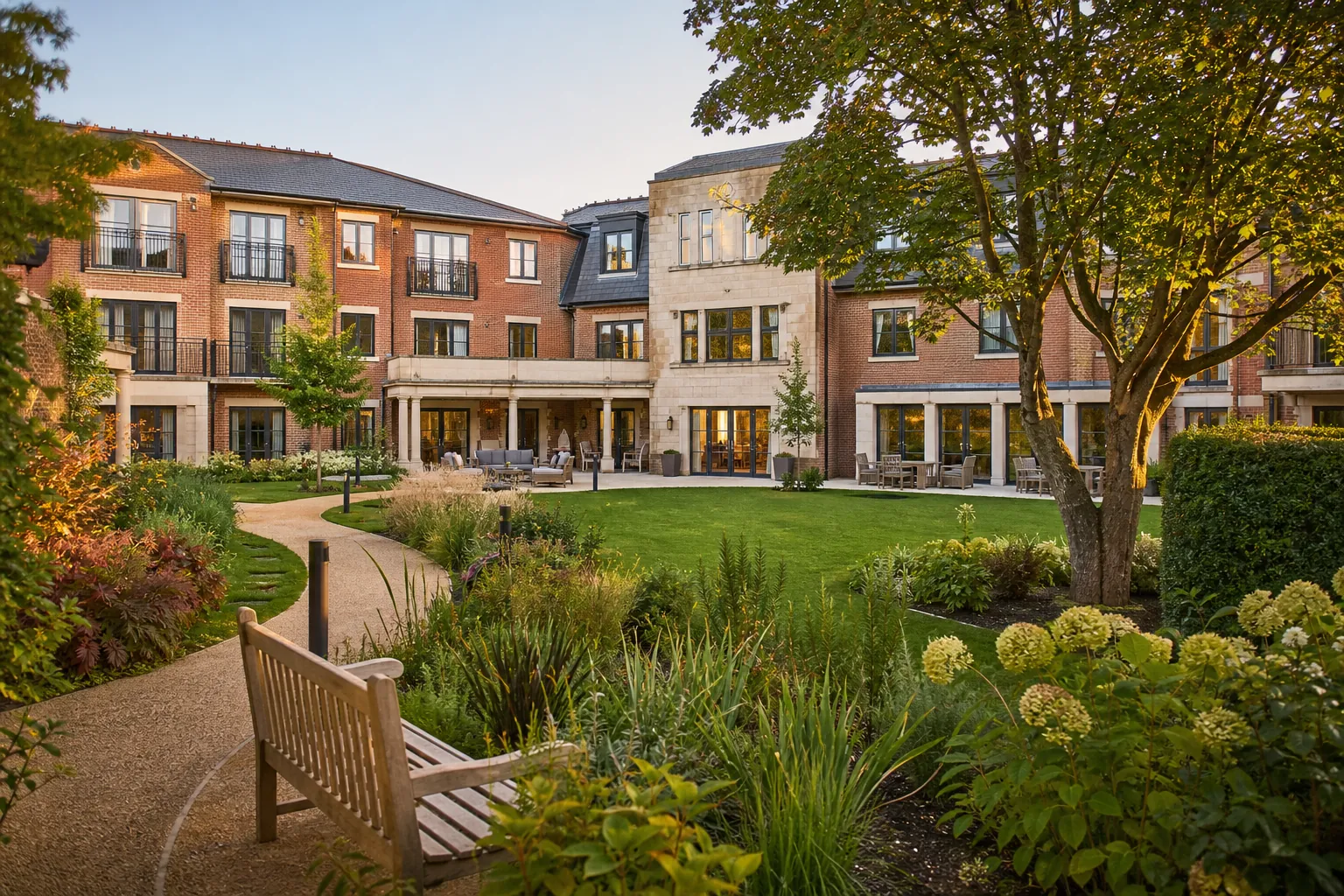
Retirement living and later living finance
Funding for retirement living and later living schemes, age-restricted homes with services for older people, financed against the sales programme, the rental income or the operator lease.

Funding retirement living
Retirement living is age-restricted housing for older people who are largely independent, where apartments or bungalows are grouped with communal facilities, a manager and optional services, funded through a service charge. Later living is the broader term for the same continuum, from these housing-led schemes through to the more care-rich extra care end. The defining feature, compared with a care home, is that residents own or rent their own home and buy services around it.
The finance follows the tenure and the income. A scheme that sells homes outright or on shared ownership is funded like a residential development repaid from sales; a rented scheme is funded on its rental and service-charge income; a scheme let to an operator is funded on that lease. We arrange development, term and refinance debt for retirement and later living, presenting the demographic demand, the scheme model and, above all, the exit the way lenders assess them.
What we fund
- Retirement living apartment schemes sold leasehold to owner-occupiers
- Shared-ownership and part-buy later living homes
- Rented retirement schemes held as an income investment
- Extra care schemes with registered care provision on site
- Schemes operated under a lease or management agreement with an operator
- Conversions and redevelopments to later living standard
Indicative terms
- Typical lot size (indicative)£2m to £30m and above
- Development funding (indicative)Up to ~60 to 70% of cost
- Term LTV (indicative)Up to ~60 to 70% of value
- Demographic contextOver-85s projected at around 3.0 million by 2043 (ONS)
Indicative only. Terms vary by lender, asset and borrower and are not an offer of finance.
Funding retirement and later living schemes
We arrange finance across the life of a later living scheme. For a ground-up or conversion development we source development finance against cost, indicatively up to 60 to 70 percent, with the exit a sales programme or a refinance onto investment debt. For a rented or operator-let scheme we arrange a term loan sized on the income, whether rental, service-charge or lease income. Where the scheme sells homes, we structure the debt around the absorption profile so the loan repays as units complete and sell. Where equity is the constraint, we introduce mezzanine finance or equity and joint venture capital. We act as arranger and introducer, not as a lender.
Which lenders fund later living, and what they assess
Later living draws residential development lenders, challenger banks, specialist living-sector lenders and, on stabilised income schemes, mainstream banks and institutional capital. What they underwrite depends on the model. On a development for sale, lenders test build cost, the planning position, and the sales rate and pricing for age-restricted homes in the catchment, where absorption can be slower than mainstream housing. On a rented scheme, they look at occupancy, the service-charge model and its competitiveness. On an operator-let scheme, the operator's covenant comes into play. The demographic backdrop supports all of it, with the over-85 population projected to reach around 3.0 million by 2043 on ONS figures and institutional money flowing into the sector, CBRE recorded £3.2bn into UK Living in Q3 2025. We match the model to the lenders active in that part of the market.
The market for retirement and later living
Later living is underpinned by the same demographic runway as the rest of the sector: the over-85 population is projected to nearly double to around 3.0 million by 2043 on ONS figures, while supply lags, and institutional appetite is strong, with CBRE recording £3.2bn into UK Living in Q3 2025. The wider assisted living market is estimated at £11.5bn growing around 9 percent a year on IBISWorld data. The exit depends on the model: a development for sale exits through the sales programme, a rented or operator-let scheme through a sale to a later living investor or operator or a refinance onto longer-term investment debt. Sales absorption is the variable lenders watch most closely on for-sale schemes, because age-restricted homes can sell more slowly than mainstream stock, so the demand thesis has to be matched by a realistic absorption assumption. We frame each scheme around the exit a lender will need to see.
Finance that suits this asset class
- Development financeFunding ground-up and conversion later living schemes against cost.
- Commercial mortgagesTerm debt on a let or operator-run later living scheme.
- RefinanceMoving from development debt onto investment debt at stabilisation.
Useful calculators
Fund a retirement living deal
A view on fundability within one working day.
What is the difference between retirement living and a care home?
Retirement living is housing first. Residents own or rent their own age-restricted home and buy services such as a manager, communal facilities and optional care around it through a service charge, keeping their independence. A care home is a registered care business where residents are looked after as part of an operating going concern. One is property with services; the other is a trading operation.
That difference drives the finance. Retirement living is funded as a residential development, an income investment or a lease, depending on tenure, while a care home is funded as trading credit on EBITDARM, occupancy and the CQC rating. We establish which model a scheme sits in at the outset, because a later living scheme and a care home go to different lenders and are underwritten on different tests entirely.
How does the tenure and income model shape the finance?
Later living income comes in three broad shapes, and each routes the deal differently. A scheme that sells homes leasehold to owner-occupiers, or part-sells on shared ownership, is financed like a residential development and the loan repays from sales. A rented scheme is financed on its rental and service-charge income, with occupancy the key variable. A scheme let on a lease to an operator is financed on that lease and the operator covenant.
Getting the model right at the outset decides the lender, the leverage and the exit. We establish early whether a scheme is a sales play, an income play or a lease-backed play, and take it to the lenders that fund that exact model rather than forcing one structure onto every scheme.
Why does sales absorption matter so much on for-sale schemes?
Age-restricted homes can sell more slowly than mainstream housing, because buyers are often selling a family home first and the market is narrower. On a development financed for sale, that absorption rate is what repays the loan, so a slow sales programme extends the debt and raises the carrying cost even where every home eventually sells.
Lenders therefore underwrite the sales assumptions hard: the pricing against local comparables, the realistic monthly absorption, and the developer's plan if sales run behind. They look for headroom in the appraisal and a credible contingency, such as a switch to renting unsold units, rather than an optimistic straight-line sell-out. We present the absorption case conservatively, because a development sized on a realistic sales rate funds far more reliably than one sized on a hopeful one.
Is later living a good investment, and how do lenders view it?
The demand fundamentals are among the clearest in UK property: an over-85 population projected to reach around 3.0 million by 2043 on ONS figures, a £11.5bn assisted living market growing around 9 percent a year on IBISWorld data, and constrained supply. That structural story is why institutional capital keeps moving into the sector.
But lenders do not lend against the demand story; they lend against an evidenced model and a defensible exit. A for-sale scheme is judged on absorption, a rented scheme on occupancy and service charge, an operator-let scheme on the covenant. We do not give investment advice; our role is to arrange the finance, and we present the scheme economics and the exit in the form a lender underwrites rather than the headline yield a seller might quote.
Can you finance a conversion or redevelopment to later living?
Yes. Redundant buildings, older retirement stock and other sites convert to later living standard where the location suits an older-buyer or older-renter catchment. The finance runs like any conversion development: the site is bought with bridging or development finance, the works are funded against cost, and the scheme exits through sales or a refinance onto income debt once let.
Lenders test the building's suitability for age-friendly design, the planning position for the use, and the demand and pricing in the catchment, alongside the cost plan. Where the works and letting or selling timetable is long, the short-term facility is sized to cover the real programme. We sequence the debt so each stage, purchase, works, stabilisation or sales, hands over cleanly to the next.
Worked example: a retirement living development for sale
Take an illustrative development: a developer builds a 30-apartment retirement living scheme with communal facilities on a site bought for £1.8m, at a build and fit-out cost of £7.2m, so £9m all-in, planned for leasehold sale to owner-occupiers. These figures are illustrative only and not an offer of finance; any real facility would be sized on the actual site, costs, planning and sales evidence.
Development finance at 65 percent of cost would advance around £5.85m, with the developer funding roughly £3.15m through equity and the land value. Where the equity requirement is tight, a mezzanine facility behind the senior loan, or an equity and joint venture partner, can complete the stack.
The loan repays from the sales programme as apartments complete and sell. Because age-restricted homes can sell more slowly than mainstream stock, the lender sizes the facility on a realistic absorption rate and looks for a contingency, such as letting unsold units, if sales run behind. The demographic backdrop, an over-85 population projected to reach around 3.0 million by 2043 on ONS figures, supports demand, but the loan is sized on the evidenced sales rate.
If the developer instead chose to hold and let the scheme, it would refinance at stabilisation onto a term loan sized on the rental and service-charge income, indicatively up to 60 to 70 percent of value, repaying the development debt and releasing equity. We size the debt against the exit actually chosen, not the demand story alone.
Illustrative worked example only. Figures vary by lender, asset and borrower and are not an offer of finance.
Frequently asked questions
What is the difference between retirement living and a care home?
In retirement living residents own or rent their own age-restricted home and buy services around it through a service charge, keeping their independence. A care home is a registered care business where residents are looked after. Retirement living is financed as housing or income; a care home is financed as trading credit on EBITDARM and the CQC rating.
How is a retirement living scheme financed?
It depends on tenure. A for-sale scheme is financed like a residential development repaid from sales; a rented scheme on its rental and service-charge income; an operator-let scheme on the lease and the operator covenant. We arrange development, term and refinance debt to match the model.
Why does sales absorption matter on later living developments?
Age-restricted homes can sell more slowly than mainstream housing because buyers are often selling a family home first. On a development financed for sale, the absorption rate is what repays the loan, so lenders underwrite the sales assumptions carefully and look for a contingency if sales run behind.
Is later living finance regulated?
Most later living finance arranged for corporate and experienced-investor borrowers is unregulated business lending. Some lending to individuals can be a regulated mortgage contract; where it is, we refer it to an appropriately authorised firm. Indicative terms are illustrative and not an offer of finance.
Funding a retirement living asset?
Tell us about the deal and we will come back with a view on fundability and likely terms.