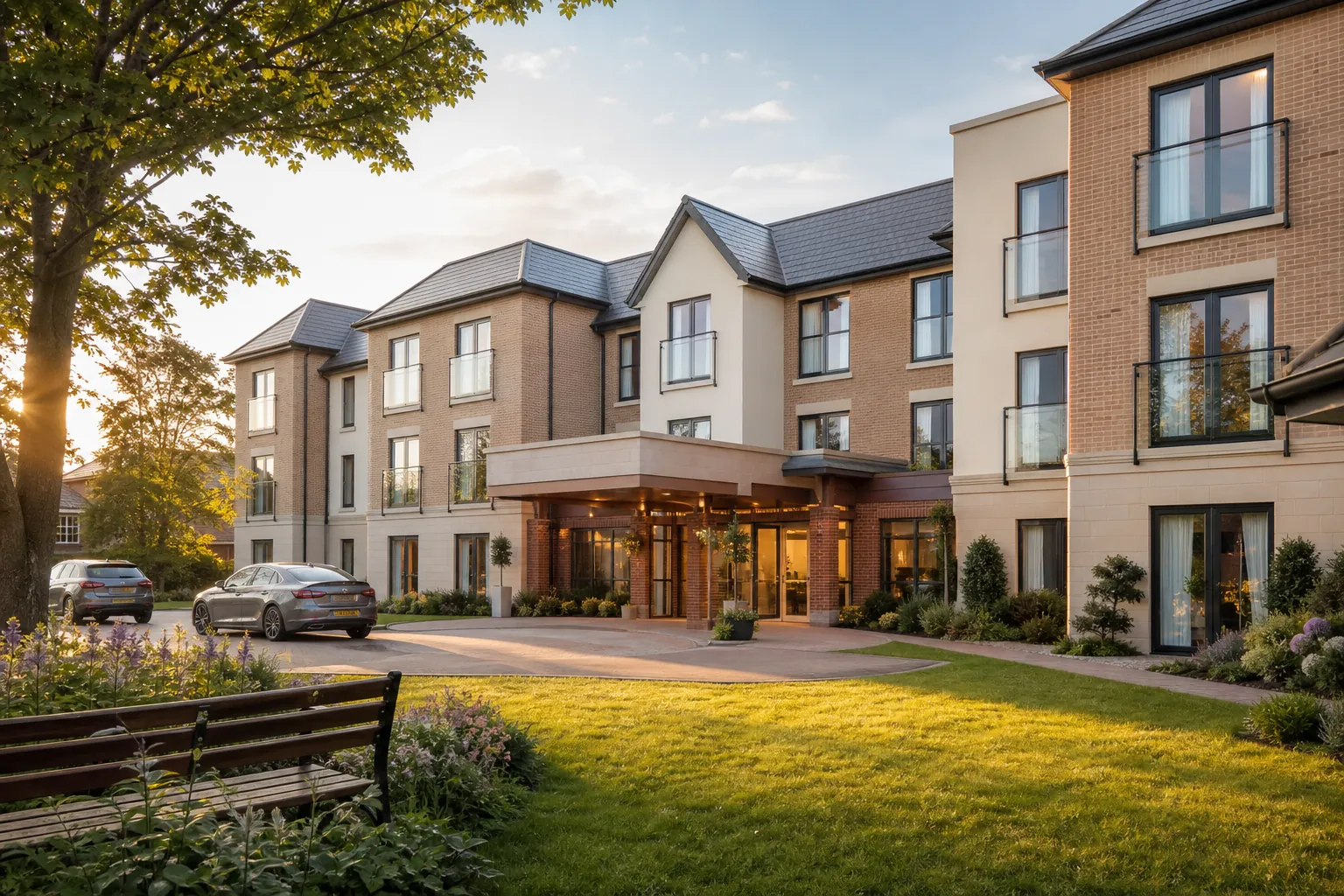
Assisted living property investment in the UK
Assisted living property investment covers age-restricted housing where care and support are available on site, spanning extra care schemes, retirement living a

Assisted living property investment covers age-restricted housing where care and support are available on site, spanning extra care schemes, retirement living and later-living developments. Unlike a care home, residents typically own or rent their own self-contained home and buy care as they need it, which gives the asset a residential character with a care wrapper. The investment appeal is the same demographic story that drives the whole sector, paired with income models that range from outright sales to long-term rental and management fees.
This guide sets out what assisted living investment looks like in practice: the formats, where demand comes from, the income models, indicative pricing and the risks, plus how schemes are financed. We arrange finance for investors and operators as a broker and introducer. We are not a lender, and nothing here is investment, tax or legal advice.
What counts as assisted living property?
Assisted living is a broad label for housing designed for older or vulnerable adults who want to live independently but with care and support close at hand. In the UK it covers extra care housing, where self-contained flats sit alongside communal facilities and a care team on site, retirement living for active older people, and later-living schemes that blend the two. It sits between mainstream housing and a registered care home on the spectrum of support.
The defining feature is that the home and the care are separate. A resident has their own front door and tenure, whether owned, shared-ownership or rented, and draws care as a service rather than as part of an institutional package. That separation matters for investors because it shapes both the income model and the planning position, and it is why assisted living can behave more like residential or build-to-rent property than like a trading care business.
Why is demand for assisted living rising?
The driver is demographic. The UK population aged 85 and over is projected to grow from around 1.6 million in mid-2018 to roughly 3.0 million by mid-2043 on Office for National Statistics national population projections, and the wider over-65 population is growing alongside it. Many of those older households own their homes and have equity to spend on housing that suits later life, which is the self-funded demand pool extra care and retirement living schemes are built to serve.
Supply has not kept pace. The UK has far less purpose-built later-living housing per head than comparable countries, and the National Housing Federation estimates the country needs up to 297,000 additional supported housing units for older people as part of a total shortfall of 179,600 to 388,100 units. The combination of a fast-growing older population, significant housing equity and a thin existing stock is why institutional capital has moved into the sector, with the wider UK Living investment reaching £3.2 billion in the third quarter of 2025 on CBRE figures.
What income models does assisted living use?
There are three broad models, and the choice shapes the whole investment. The for-sale model develops units and sells them to older buyers, often with an ongoing service charge and sometimes an event fee or deferred management fee payable on resale, which gives the operator a long-term income tail. The rental model retains the units and lets them, producing a recurring income stream closer to build-to-rent. The mixed model blends sale and rental within one scheme.
Care income sits on top of the housing income in each case, whether delivered by the operator or a third party. For an investor, the model determines whether the return comes mainly from development profit on sales, from long-run rental and fee income, or from both. The estimated UK assisted living market was worth around £11.5 billion and has grown about 9 percent a year over the past five years on IBISWorld figures, which is the scale of the opportunity these models are competing for.
What pricing and yields apply to assisted living?
Pricing depends heavily on format and income model. Stabilised, income-producing later-living and extra care schemes with a strong operator have attracted institutional capital at yields broadly in line with the wider living sectors, where prime care home yields sat at around 4.5 percent on the Knight Frank UK Living Sectors Yield Guide for September 2025 and specialist supported housing at around 5 to 6 percent on the same source. Retirement and extra care schemes price between those reference points depending on covenant, tenure and location.
For-sale schemes are valued differently, on development appraisal and sales values rather than on a yield, because the return is realised through unit sales rather than rent. Affluent areas with high home equity, particularly across the South East, South West and London, support the strongest sales values and self-funded demand, while rental schemes lean on areas with deep need. The practical point is that there is no single assisted living yield: the number depends on whether you are buying income, building for sale, or both.
What are the main risks?
Operational and lease-up risk lead the list. Extra care and later-living schemes are complex buildings with care, catering and communal services, and a scheme that fills slowly or is run poorly underperforms regardless of the demographic backdrop. For-sale schemes carry sales-rate risk: if units sell more slowly than the appraisal assumed, the development return erodes and finance costs mount.
Then come the model-specific risks. Event fees and deferred management charges on for-sale schemes have drawn consumer scrutiny, so the terms have to be fair and clearly disclosed. Care delivery is regulated by the Care Quality Commission where it is registered, and a poor rating affects both reputation and value. Planning can be contested, since later-living schemes are sometimes treated as residential and sometimes as institutional use depending on their design and care offer. As with all property, leverage magnifies each of these risks, which is why the funding has to be sized against a realistic, not an optimistic, business plan.
How is assisted living financed?
The finance route follows the income model. A stabilised, income-producing extra care or retirement scheme is funded with a commercial mortgage or investment loan sized against value and rental income. A ground-up extra care or later-living development is funded with development finance drawn against build milestones, often measured on loan to cost and loan to gross development value, with an exit either onto an investment loan once the scheme is trading or through unit sales.
For-sale schemes lean on development finance with sales as the exit, and forward-funding or forward-purchase by an institution can de-risk delivery where a buyer is lined up in advance. Bridging finance bridges timing gaps, such as buying a site ahead of planning or a building before conversion. We arrange acquisition finance, development finance, bridging and refinance across the lenders active in later living and extra care, as a broker and introducer rather than a lender, and we can structure the senior, mezzanine and equity layers together so the whole capital stack is priced before you commit.
Assisted living property investment in the UK: common questions
What is the difference between assisted living and a care home?
In assisted living, such as extra care or retirement living, the resident has their own self-contained home and buys care as a service, keeping their own tenure. In a care home the resident lives in an institutional setting where accommodation and care are provided together as a package. The distinction affects the income model, the planning use class and how the asset is financed and valued.
Is assisted living a good property investment?
The structural case is strong: the over-85 population is projected to reach around 3.0 million by 2043 on ONS projections, the UK assisted living market was worth around £11.5 billion growing about 9 percent a year on IBISWorld figures, and there is a large later-living supply shortfall on National Housing Federation research. Whether a specific scheme is a good investment depends on the income model, the location, the operator and the price, which is a decision for you and your advisers.
How do you make money from assisted living property?
Through one or more of three routes: development profit from building and selling units, long-run rental and service-charge income from retained units, and event or deferred management fees payable on resale in for-sale schemes. Care income can sit on top of the housing income. Which route dominates depends on whether the scheme is for sale, for rent or mixed.
What yield does assisted living pay?
There is no single figure, because pricing depends on the format. Stabilised income-producing schemes price broadly in line with the wider living sectors, where prime care home yields sat at around 4.5 percent and specialist supported housing at around 5 to 6 percent on the Knight Frank UK Living Sectors Yield Guide. For-sale schemes are appraised on sales values rather than a yield.
Ready to talk about a real deal?
Send us the deal and we will come back with a view on fundability and likely terms within one working day.